Cycling Saddle Soreness: A Clinical Perspective

Bike saddle soreness that won't quit? It isn't just in your head.

When sit bone pain and perineal pressure occur together, the saddle isn't a minor inconvenience — it's actively working against your body. Cyclists who experience both symptoms have a compound problem that padded shorts and chamois cream cannot solve.

If you're experiencing both sit bone pain and numbness or soft tissue pressure, this is not a conditioning issue or a fit issue. It is a saddle architecture problem.

The good news is: Zeta Saddles have a clear and documented solution, combined with Reactive Padding, it's a combination that can't be beat.

The Combined Pain Pattern

Most cyclists who live with chronic saddle soreness are experiencing two distinct failure modes simultaneously — one structural, one vascular. Standard saddles fail at both. Understanding which tissues are involved is the first step toward resolving it.

Sit bone pain

  1. Ischial tuberosities bearing load on inadequate saddle platform
  2. Bruising, bursitis, or chronic tenderness at contact points
  3. Worsens with ride duration — becomes limiting factor
  4. Does not resolve with rest alone when saddle is unchanged

Perineal pressure & numbness

  1. Saddle ridge or nose compressing perineal artery and pudendal nerve
  2. Tingling, partial numbness, or complete loss of sensation mid-ride
  3. Off-bike symptoms persisting hours after dismounting
  4. Recovery time lengthening with repeated exposure

The design of the saddle, along with Reactive Padding give you a solution that will eliminate the pain, or your money back.

  • Soreness after longer rides

    • Sit bone tenderness after 60+ minutes
    • Occasional perineal pressure on climbs
    • Resolves within a day
  • Both symptoms, every ride

    • Sit bone pain within 30 minutes
    • Numbness setting in on most rides
    • Affecting mileage and consistency
  • Limiting or stopping riding

    • Chronic soreness between rides
    • Persistent off-bike numbness or sensitivity
    • Multiple solutions attempted and none worked

What You've Probably Already Tried

Cyclists with chronic combined saddle soreness rarely arrive here without a history of attempted fixes. Here's why most of them don't work and why that's not your fault.

Padded shorts / bib upgrades

Chamois adds cushion but doesn't change the contact geometry. If the saddle is compressing the wrong tissue, more padding compresses it more softly — not less.

Chamois cream

Addresses skin friction and chafing — a different problem. Has no effect on ischial bursitis or perineal nerve compression.

Saddle tilt adjustments

Changing saddle angle redistributes load but cannot fix a saddle with insufficient channel depth or wrong sit bone width. A geometric problem needs a geometric solution.

"Saddle break-in" time

Saddles don't break in — tissue does. What feels like adaptation is often scar tissue formation at chronic pressure points. Not the same thing.

The reason these don't work: they treat symptoms without addressing the source. Both sit bone pain and perineal numbness are caused by saddle geometry — specifically, inadequate sit bone platform width and the absence of a true central relief channel. Until the geometry changes, the symptoms don't resolve.

Two Failures. One Root Cause.

The standard cycling saddle was not designed around clinical anatomy. It was designed around manufacturing convention. The result is a shape that concentrates load in two places that cannot tolerate sustained pressure: the ischial tuberosities without adequate platform support, and the perineal zone without adequate channel clearance.

Why sit bones hurt

The ischial tuberosities (sit bones) are bony prominences designed to bear seated load — but only when supported across their full width. A saddle too narrow for your pelvis forces the sit bones to bridge the edge, concentrating pressure into a small contact zone. Sustained load produces ischemia, bruising, and inflammation of the ischial bursa.

Why numbness occurs

When the sit bones are not properly supported, the pelvis rotates forward to find stability — transferring load onto the perineal zone. The saddle nose or central ridge then compresses the pudendal nerve and perineal artery. Blood flow restricts. Sensation diminishes. The two symptoms are mechanically linked — fix one, you address the other.

#1 Zeta ranked first of 16 saddles in gebioMized real-rider pressure testing.

Zero perineal contact pressure measured on Zeta in third-party pressure mapping.

One saddle addresses both failure modes simultaneously: sit bone platform + full central relief.

Engineered For Both Problems At Once

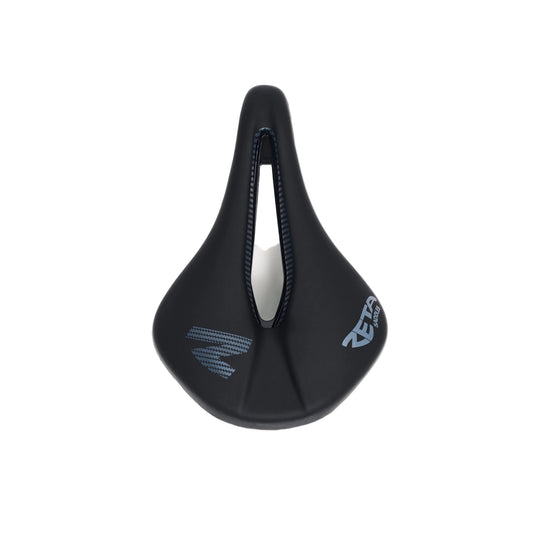
The Zeta Saddle was designed by Dr. Patrick O'Shea, DC, specifically because no existing saddle addressed both failure modes in a single architecture. The result is a saddle where sit bone load and perineal clearance are solved together, not traded off against each other.

Anatomically mapped sit bone platform

Platform width and curvature derived from clinical pelvic data not industry averages. Sit bones are fully supported across their contact width, eliminating the bridging effect that causes bursitis and chronic bruising.

Full-relief central channel. Zero perineal contact

A structural void, not a cosmetic groove, maintains complete clearance from the perineal zone under real rider load. Confirmed by gebioMized pressure mapping: zero contact pressure measured in the perineal region.

Zone-differentiated foam density

Firmer under the sit bone platform for load-bearing stability. Softer in the surrounding zones for natural pelvic movement. Solving both problems simultaneously requires the foam to behave differently in different zones. Most saddles don't do this.

Also Validated on real riders: See our reviews

gebioMized saddle pressure testing used actual cyclists in real riding positions. Zeta ranked first among 16 saddles. The only test protocol where body mechanics under load, not static measurement, determined the result. Our reviews back this up.

Dr. Patrick O'Shea, DC

Founder, Zeta Saddles — Sports Chiropractor & Cyclist

"The cyclists I see with chronic saddle soreness have almost always tried everything except changing the saddle geometry. Shorts, cream, angle adjustments — none of it changes the root cause. I built Zeta because the saddle market was not solving the problem the way clinical biomechanics would demand it be solved."