
Pressure Investigation
Why Softer Saddles Hurt More
An engineer set out to disprove a padding claim. The independent pressure test that followed shows why “softer” and “more comfortable” aren’t the same thing.

If your saddle hurts, the advice you usually get is “get more padding.”
So riders buy gel covers, thicker foam and wider, plusher saddles. For the first ten minutes it feels better. By mile fifteen the numbness, the hot spots and the soreness come back, and sometimes they’re worse than before.
I see the results of this in my clinic. As a chiropractor who works with cyclists every week, I kept hearing the same story from riders who had “tried everything.” Most of them had made the same reasonable assumption: that soft means comfortable.
The pressure data says otherwise.
The problem with “soft”
Your pelvis isn’t flat. You’re built to carry load on two bony points, the sit bones, while the soft tissue between them handles very little. The soft tissue is where nerves and blood vessels run.
A good saddle keeps load on bone and off soft tissue. That’s where soft padding works against you.
Sit bones sink in first
They’re the narrowest, hardest points, so they press through soft padding until it bottoms out.
The padding gets displaced
It bulges up around and between your sit bones, into the area you most want to protect.
Load moves to soft tissue
The surface now presses upward right where pressure causes numbness and discomfort.
Think of a soft mattress that seems lovely in the store but leaves your back aching after a week. Being soft doesn’t give you support, and often it does the opposite.
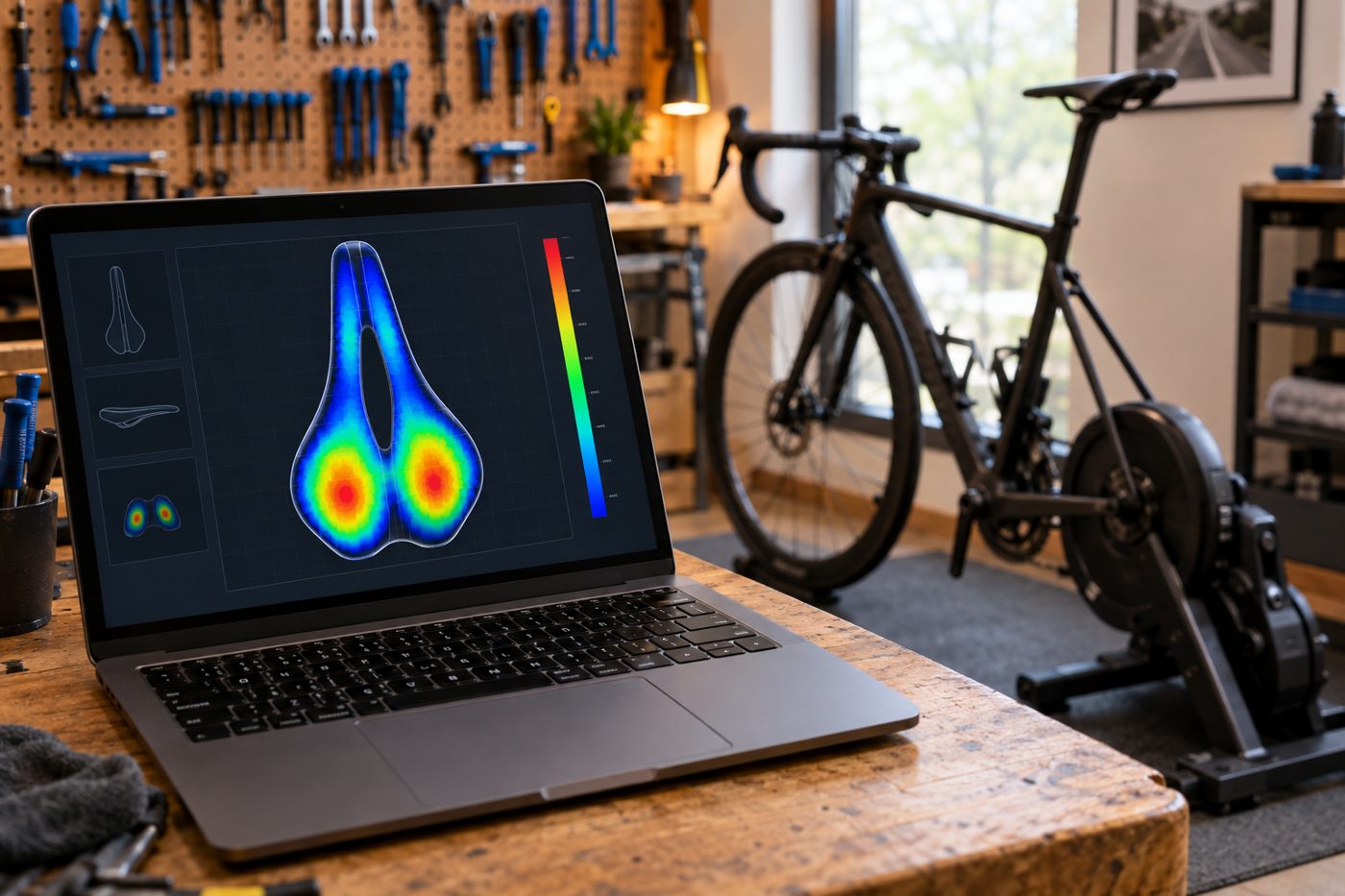
An engineer challenged us. So we tested.
When we launched Zeta’s Reactive Padding, not everyone believed us. One engineer publicly challenged our claims. We didn’t argue online. We invited him to run his own test.
He ran an independent pressure-mapping session with professional bike fitter Justin Lucke, using gebioMized, a sensor system fitters use to measure exactly where a rider’s weight lands on a saddle. Zeta paid only for the studio’s time. The engineer was not paid. We then put a set of well-known premium saddles on the same mat.
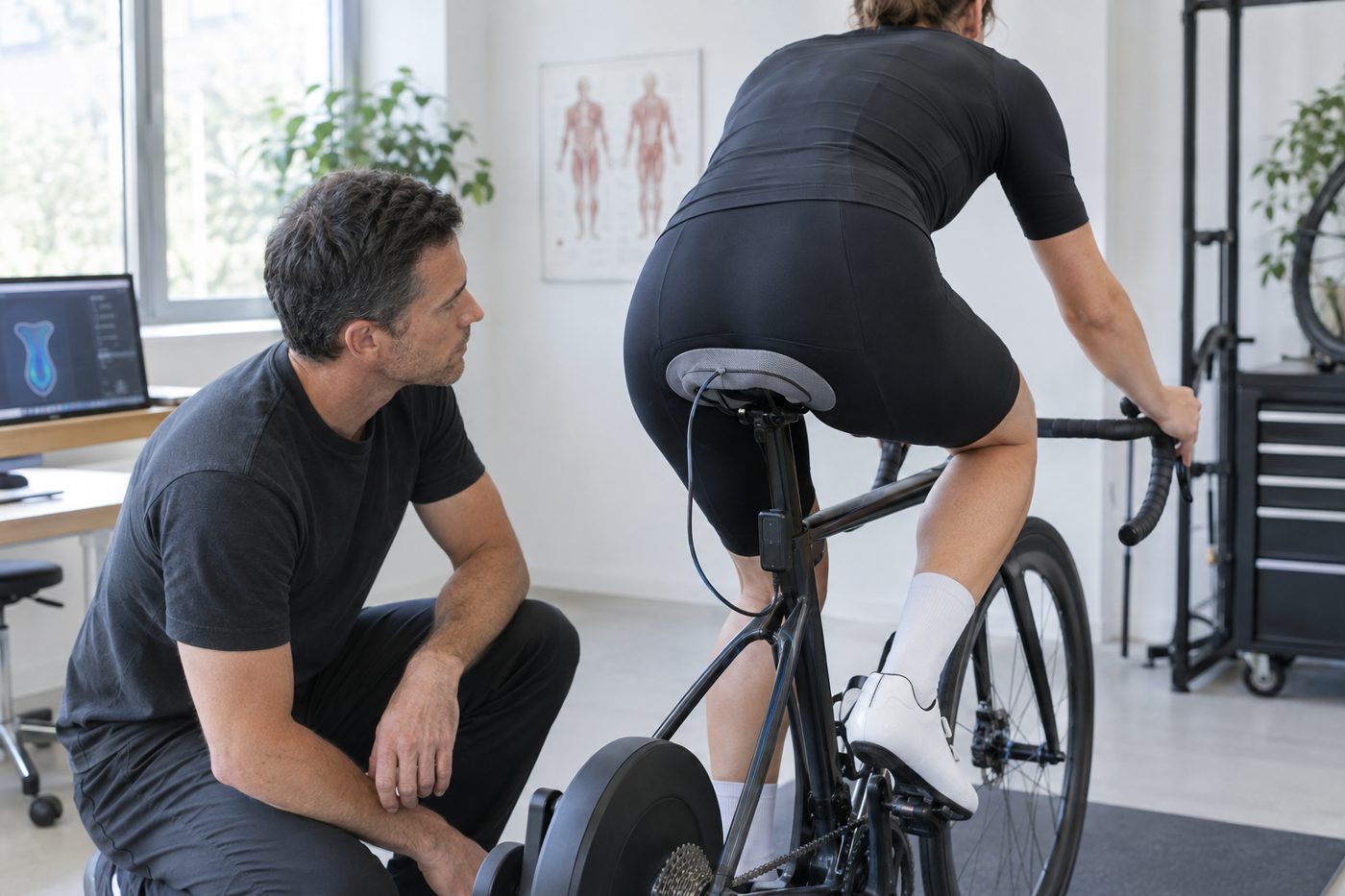
The protocol
- Saddles
- Nine setups: five conventional saddles and three Zeta models, with the Modus run at two nose angles
- Rider
- One rider, one road bike, one continuous session
- Testers
- Eugene Bernosky, engineer, and Justin Lucke, professional bike fitter
- Chamois
- Each saddle run with a 3 mm and a 12 mm chamois. Rankings matched; 12 mm results shown
- Position
- Fitter set each saddle’s position individually
- Condition
- Saddles tested bare, with no covers or aftermarket padding
- Sensors
- gebioMized saddle pressure mapping
- Date
- 3 April 2024
The results
What the pressure mat measured
Peak pressure in millibar (mbar), 12 mm chamois. Lower is better. Zeta saddles Conventional saddles
Perineal (soft tissue)
Peak pressure where nerves and blood vessels run
- Zeta Ultima447
- Zeta Optima499
- Selle Italia Carbonia SLR589
- Zeta Modus · −0.9°666
- Zeta Modus · −1.5°678
- Specialized Mirror703
- Specialized Power Mimic920
- Selle Italia Boost922
- Selle SMP1194
Sit bones
Higher of the left and right peak readings
- Zeta Modus · −1.5°830
- Specialized Power Mimic909
- Zeta Modus · −0.9°934
- Zeta Ultima961
- Zeta Optima988
- Specialized Mirror1084
- Selle Italia Carbonia SLR1097
- Selle SMP1252
- Selle Italia Boost1435
Zeta Ultima recorded the lowest perineal peak, 24% below the best conventional saddle (Selle Italia Carbonia SLR, 589).
Zeta Modus at −1.5° recorded the lowest sit-bone peak, 9% below the best conventional saddle (Specialized Power Mimic, 909) and well below the Specialized Mirror (1,084).
No conventional saddle recorded lower pressure than a Zeta model in both zones.
The trade-off is easy to see. Among the conventional saddles, the one with the lowest perineal pressure had the third-highest sit-bone pressure. The one with the lowest sit-bone pressure had the third-highest perineal pressure.
That trade-off is the pattern that matters for comfort. You want lower pressure peaks on the sit bones and lower pressure on soft tissue, at the same time. Adding softness doesn’t get you there, because it tends to trade one problem for the other. What gets you there is controlling how pressure spreads.
How Reactive Padding is different
Reactive Padding isn’t simply a softer cushion. It’s a patented, multi-layer platform built for progressive pressure distribution.
- It responds to load. Light contact feels comfortable. As pressure rises under the sit bones, the platform firms up progressively and doesn’t bottom out.
- It spreads load instead of displacing it. Pressure is spread across the support area rather than squeezed into the center.
- It’s tuned. Layer count, density, thickness and shape are engineered for each model and how it’s meant to be ridden.
Combined with pelvic-support geometry (shell shape, channel and width designed around how riders actually sit), the goal is simple: keep the load on bone, and keep it off you.
Who this is for
You’ll likely notice the difference if you:
- Get numbness, tingling or soft-tissue pressure on rides over 30–60 minutes
- Have already tried a gel saddle or cover and it didn’t fix the problem
- Ride an e-bike, hybrid or endurance bike in a more upright position
- Are coming back to cycling and assumed discomfort was just part of it
Discomfort isn’t a rite of passage. Usually it’s a pressure problem, and pressure problems can be measured and solved.
Find your Zeta
Judge your saddle by pressure, not padding.
30-day money-back guarantee. Order your saddle, set it up and ride it. If it doesn’t give you the ride we claim, return it within 30 days for a full refund.